2025-11-13
Mercari Updates Marketplace Principles, Introducing New Measures for Safety and Security and Publishing White Paper
Share


Mercari was founded upon a mission to “create value in a global marketplace where anyone can buy & sell,” and has continued to grow since then. However, recent incidents have highlighted the importance of ensuring user safety and security.
To address the situation, Mercari held a press conference on October 9, 2025, about the company’s updated Marketplace Principles. The company published a white paper addressing the thought process and discussions behind the update and the new response measures it has established to ensure the safety and security of the marketplace. Additionally, Mercari announced that it would introduce response measures to address items that have the potential to significantly impair the safety and security of its marketplace, such as items associated with a high number of fraudulent listings/incidents and items that have extreme fluctuations in price. These measures may include prohibiting listings of the item.
This announcement was made based on discussions during meetings for the 5th Advisory Board on the Ideal Form of a Marketplace, held in July and September 2025, and clarifies Mercari’s stance of creating a safer and more secure transaction experience while upholding the concept of a diverse and free marketplace.

The role of the marketplace in achieving Mercari’s goal to “circulate all forms of value”

At the beginning of the press conference, Mercari Executive Officer and Senior Vice President of Japan Business Masato Yamamoto reiterated the company’s mission. “At Mercari Group, our mission is ‘circulate all forms of value to unleash the potential in all people.’” The starting point of this circulation of value is Mercari’s diverse and free marketplace.
The Mercari marketplace app was launched in 2013 as a platform for matching items that are no longer needed or have untapped value with other people who need them, thereby creating new value. Since then, the app has expanded to a scale of 23 million monthly users and a total of 4 billion listings. Additionally, the launch of services like Mercari Shops has transformed Mercari into a marketplace for trading not just unneeded items but all things that may have value.
Mercari’s key strengths lie in the diversity of items—used, like-new, and brand-new—made available through both C2C and B2C transactions, and the freedom users have to buy and sell them.
The “new value” circulated by Mercari
Masato then continued by providing specific examples of how Mercari creates new value. “Mercari creates new value in different ways, whether it be in the form of a discontinued magazine, a classic black telephone from the Showa era, or a single earbud in a pair, all of which cannot be found in regular stores.”

“With such a wide variety of items being bought and sold on Mercari, the users themselves are the ones who decide the prices, uses, and value of items. This diverse and free market is the foundation of active transactions unique to Mercari.
Masato stated that no other marketplace could unleash the potential in all people like Mercari. He gave some specific examples of how Mercari is unleashing people’s potential, such as one person who started playing golf thanks to Mercari, and another who was so successful on Mercari Shops that they were able to open a physical store.
Formulation of the Marketplace Principles in response to the COVID-19 pandemic
On the other hand, the increase in popularity of marketplace apps has revealed some challenges. In particular, during the spread of the COVID-19 pandemic in 2020, various supplies became scarce across the world, one example being face masks.
Regarding the situation at the time, Masato reflected that, “The pandemic highlighted to marketplace operators the limitations of simply classifying transactions as ‘legal or illegal.’ It became necessary for platforms to take responsibility by creating criteria for restricting certain legal transactions.”
“The absence of such criteria at the time often resulted in situations where social media controversies would compel decisions to be made for each individual case without time for due assessment. This led us to recognize that new rules, or principles, were needed to serve as a transparent and consistent decision-making standard.”
Based on this, in July 2020, Mercari established the “Expert Panel on the Future of Marketplaces,” including external experts from various fields such as economics, corporate ethics, and ESG. “The purpose of this panel was to discuss the more universal nature of marketplaces from diverse perspectives, while also directly addressing the issue of responding to supply and demand pressures during the COVID-19 pandemic.”
The Marketplace Principles were formulated in 2021 after six months of discussions by the Expert Panel on the Future of Marketplaces. Mercari is still operated in line with these principles to this day.
A transparent discussion process involving external experts
Next, Masato entered into a deeper explanation of the Marketplace Principles. “The Marketplace Principles serve as the foundational ideas that support all users of our marketplace. They are not rules, but rather a summary of the principles behind our Terms of Service, guidelines, and other policies, with the goal of achieving a more transparent marketplace.”

Masato also emphasized that external experts were involved in the process of formulating the Marketplace Principles, and that meeting summaries were made public to ensure transparency.
According to Masato, the core idea behind the principles was to create a marketplace where people with diverse values can trade items freely.
He also stated that, “Mercari is operated with the aim of creating the most matches possible between its diverse range of sellers and buyers.” “We believe that the diversity of the values held by our users and the freedom of transactions facilitate efficient matches between the buying and selling needs of each individual, creating more ‘new value’ for everyone.”
The concept of “externality” and the adoption of the “harm principle”
While Mercari aims to match supply and demand needs through free transactions, during the COVID-19 pandemic, the balance of supply and demand became significantly disrupted in some cases. This was particularly prevalent in transactions involving face masks and rubbing alcohol, which escalated into an issue that needed to be addressed.
To do so, we referenced the concept of “externality.” Masato explained that, “We decided to intervene when the transaction was determined to have ‘externality,’ which refers to an impact on not just the buyer and seller involved in the transaction, but also third parties and ultimately society as a whole.”
Taking face masks during the COVID-19 pandemic as an example, Masato said that “wearing a mask not only prevents infection for the individual buyer but also brings about a ‘positive externality’ that reduces the infection risk for those around them. If trading through Mercari as an intermediary makes it harder for face masks to reach those who need them, this compromises the benefits to society as a whole.


The panel also discussed the “harm principle” and its contrasting concept, the “offense principle.” After considering both, the panel concluded that the criterion for intervention as stated in the principles should be based on the “harm principle,” which can serve as a more objective and clear standard. Masato offered the following background information from past discussions: “The ‘offense principle’ refers to a subjective feeling of discomfort, and may lead to arbitrary intervention by marketplace operators. We decided that we should only actively intervene when the items or actions associated therewith have a high probability of directly and clearly infringing fundamental rights such as the life, body, or property of others. That’s not to say that we will completely disregard the offense principle, but we felt that transactions should be judged based on whether they are ethical or humane rather than on personal emotions.”
Formulation of the three principles
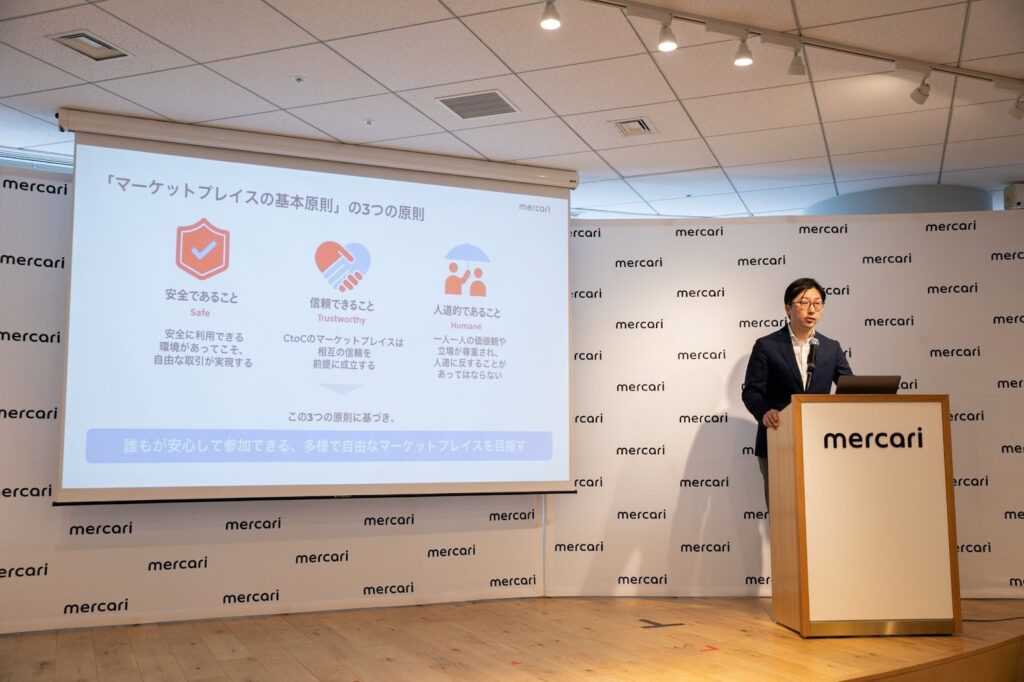
Masato explained that, in light of these discussions, there was a consensus that ensuring safety is essential to creating a diverse and free marketplace. This led the panel to formulate three main marketplace principles.
The three principles are as follows.

- Safe
- Trustworthy
- Humane
Reference: The Marketplace We Envision
Specific restrictions and current issues
Masato then proceeded to introduce specific examples of restrictions that were imposed based on the principles. In actual practice, Mercari has a committee that meets weekly to discuss the safety and security of the marketplace. Masato gave real examples of issues that were recently restricted through discussions by this committee.
Examples of applying the ‘safe’ principle

Hygiene products during the COVID-19 pandemic (2021; currently lifted): Considering the situation of the COVID-19 pandemic, face masks and rubbing alcohol were deemed “items that are essential to protecting people’s health and/or safety and should be widely distributed as quickly as possible but are in notably short supply.” Therefore, we banned listings.
Government-managed stockpiled rice during the rice supply crisis (2025): While there was no request to ban listings from the government at the time, this rice was intended for stable distribution to consumers and was deemed a “daily necessity with a significant supply shortage.” Therefore, we prohibited listings.
Empty shell casings (2025): While the possession and trading of shell casings are not legally regulated, it was determined that shell casings are likely to encourage illegal and criminal activities based on information we received from the National Police Agency. Therefore, we banned listings starting July 21, 2025.
Societal changes and new challenges
Masato then shared details on the current situation of online marketplaces—namely, that more emphasis is being placed on safety today. In May 2025, Mercari announced two new policies: “thorough elimination of fraudulent users” and “thorough aid for users.” Masato stated that, “It is our ongoing responsibility to create an environment where users can use our services safely and securely while protecting our diverse and free marketplace.”

Review system for the Marketplace Principles
Masato also emphasized that the Marketplace Principles are not static. “The Marketplace Principles are regularly reviewed every six months by the Advisory Board on the Ideal Form of a Marketplace, taking into account societal changes and dialogue with external experts.”
The Marketplace Principles were established in 2021 during the COVID-19 pandemic, and it has been nearly five years since discussions began. “Recently, we have seen transactions involving items with a significantly disrupted supply-demand balance, which have compromised safety and security within the marketplace. I am aware that we will need to re-examine the principles in line with such changes,” Masato said, demonstrating the company’s awareness of current issues.
Discussions at the 5th Advisory Board meetings and the introduction of new measures
Next, Shunsuke Sako, Vice President, Chief Executive Officer (Marketplace) took to the stage and detailed the discussions at the 5th Advisory Board. “As explained earlier by Masato, the Marketplace Principles are not a fixed set of rules that will never change. They will be regularly reviewed by the Advisory Board on the Ideal Form of a Marketplace in collaboration with external experts and, if necessary, revised based on societal changes and through dialogue.”

Clarification of issues and causes for discussion
“Lately, there have been some listings that compromise safety and security for users and are not in line with our principles as a ‘Safe,’ ‘Trustworthy,’ and ‘Humane’ marketplace. Specifically, immediately after the release of a popular game console in June this year, there was a surge in fraudulent listings and defamatory comments on the Mercari marketplace, leading to situations that compromised user safety and security.”
This issue was addressed at Advisory Board meetings held in July and September 2025, which involved discussions with external experts about Mercari’s approach and recent actions, as well as the formulation of new response measures.
Response to popular game console and evaluation by experts
Shunsuke explained the specific countermeasures Mercari has taken. “While we have not prohibited the listing of this popular game console based on the Marketplace Principles, we have implemented some response measures to address the issue of safety and security. These measures include raising awareness with manufacturers, deleting listings that violate our Terms of Service, addressing fraudulent activity and incidents based on our Terms of Service and guidelines, and making identity verification mandatory for high-value transactions.”
Of these initiatives, the Advisory Board published the following opinions and proposals:
“We rate Mercari’s response highly in terms of upholding the Marketplace Principles.”
“However, from the perspective of protecting the company’s reputation, alternative approaches might have been considered.”
Discussion on exceptions to the rules
Another important discussion concerned how to handle items that the company may want to restrict, including through outright bans, but that would be difficult to justify under the Marketplace Principles. Regarding this, the Advisory Board expressed the following opinions.
“In terms of the relationship between Mercari’s response and the Marketplace Principles, we believe that it may be best to treat the response as an exception to the rules without changing the principles;” “Since the response is merely an exception to the Marketplace Principles, it is important to establish in advance the criteria for taking that response and the internal discussion process, as well as to inform users of this in some way.”
“As one criterion for implementing a response as part of our management strategy, we should not make judgements based on vague terms like ‘social responsibility’ or virality on social media, but rather based on consistency with our medium-term business plan.”
Specific issues arising from the popular game console and the introduction of new response measures
Shunsuke then provided more background to the issues Mercari faced when the popular game console was released. “When the game console was released, we were faced with incidents that undermined the safety and security of the marketplace, such as listings aimed to mislead buyers and acts of defamation against sellers.”
“Although we quickly took measures such as deleting listings and restricting account usage to address both issues, the fact that these issues occurred in the first place compromised user safety and security. In light of this situation, we believe that discussions and considerations around updating to the Marketplace Principles are necessary to enhance user safety and security in the marketplace.”
Through Advisory Board discussions, Mercari decided to implement new response measures. Shunsuke announced, “We may take action against items that have the potential to significantly impair the safety and security of our marketplace, such as items associated with a high number of fraudulent listings/incidents and items that have extreme fluctuations in price. These actions may include prohibiting listings of the item.”
Any such action will be made after comprehensive consideration of factors including rapid increases in fraudulent listings/incidents, defamation, extreme fluctuations in price, and other phenomena that compromise safety and security.

Additionally, as part of efforts to improve transparency, Mercari also announced that it has published a white paper summarizing the history of the Marketplace Principles from their formulation to this recent update. “We want to build a more trustworthy marketplace,” Shunsuke concluded.
Summary: New phase for Mercari’s marketplace operations
Key points of this announcement
- Mercari stands firm in its ideals to be a diverse and free marketplace that everyone can participate in without worry
- Mercari will introduce new response measures while upholding the fundamental principles (safe, trustworthy, humane)
- Mercari will strengthen action against items that have the potential to impair the safety and security of our marketplace, such as items associated with a high number of fraudulent listings/incidents and items that have extreme fluctuations in price
- Mercari will continue to emphasize ongoing dialogue with external experts and transparency in its decision-making process
This announcement marks an important step in demonstrating that Mercari has made updates to protect user safety and security while preserving the value of the diverse and free marketplace it has built over the past 12 years. Going forward, we will continue to publish information about specific operational standards and details of our decision-making processes.
Share