


2025-12-12
The Challenge of Publishing Unprecedented Data: How Mercari Created Its First Transparency Report
Share


On September 1, 2025, Mercari released its first-ever Transparency Report. The report includes sensitive figures that had previously never been disclosed by Mercari—or by most companies in the industry. These metrics include a 0.4% inquiry rate related to item issues (incident rate) and a 1.9x increase in compensation provided to users. Mercari’s choice to disclose figures that competitors shy away from publishing reflects the company’s aim to create a marketplace where anyone can buy and sell with greater peace of mind.

In recent years, rising fraud risks have made trust and safety more important than ever. Mercari has been reinforcing its commitment to safe transactions, but until now most of these efforts have remained internal and largely invisible to users. Mercari published the Transparency Report because we believe that helping users feel safer means sharing both our challenges and our progress—backed by real, concrete numbers. Choosing to publish figures that had never been disclosed before required us to make a clear, collective commitment to honesty and transparency.
Behind the creation of the Transparency Report were high expectations from across the company, complex coordination between data analysts and other stakeholders to address competing requests, and above all, a shared belief that Mercari should always be honest with its users. To get the inside story, we spoke with five members involved in the project: Takashi Betsui (@betts3), @nakakoh, @mai.i, and @umenok from the Trust and Safety (TnS) team, as well as @Haru.H from the PR team.
This article was composed and written using AI tools based on an audio recording of the session. This English version was translated from Japanese using a custom generative AI model trained on Mercari’s editorial style guides and past Mercan articles.
Only members who were available for the photo shoot appear in the images.
Featured in this article
-

Takashi Betsui (@betts3)
Takashi works in Mercari’s TnS organization. He previously supported a wide range of corporate communication activities in the advertising industry, including PR planning, digital media strategy, and social media crisis prevention. He later joined a social media monitoring tool vendor, where he provided SNS risk mitigation support. Since joining Mercari in February 2022, Takashi has built the company’s social media monitoring framework while on the Customer Support (CS) team. In TnS, he has produced analytical reports on rights-holder support, fraud countermeasures, and user protection. He currently handles content moderation on the policy development team.
-

Koichiro Nakayama (@nakakoh)
Koichiro joined Mercari in 2022 after working for a government agency. He first handled marketplace-related policy matters on the Public Policy team before transferring to the TnS organization. Today, as manager of the Partner Management Team, he oversees collaboration with companies and organizations on trust and safety initiatives.
-

Mai Ikeda (@mai.i)
Mai joined Mercari in 2016 after working as an operator for an apparel e-commerce site. She launched the Risk Control team within CS, then, after returning from maternity leave, moved to the Partner Management Team, where she handled corporate relations and data analysis. She also contributed to the administrative side of creating analytical reports on fraud countermeasures and user protection. Today, she manages responses to primary-distribution companies and rights holders, serving as a bridge between external partners and internal operations. She shares her home with two large, beloved cats.
-

Kentaro Umeno (@umenok)
Kentaro joined Mercari in 2022 after experience in restaurant management and partner management for a global e-commerce platform. Within the TnS organization, he has overseen external relations and led teams responsible for marketplace rulemaking. He now serves as a senior manager overseeing multiple teams across the TnS organization.
-

Mitsuharu Hayasaka (@Haru.H)
After working for a government agency, Mitsuharu joined Mercari in 2021. In the Public Policy team he handled fintech-related policy matters before moving to the PR team, where he now leads communications related to fraud prevention, AI, and financial results.
Why Mercari chose to publish the Transparency Report, and the team behind it
—First, could you tell us what led to the decision to publish the Transparency Report?
@betts3: We have been working to improve the user experience through various initiatives, and it became clear to us that we needed to communicate these efforts more openly. At first, we imagined publishing something like a “Trust & Safety Report.”
@Haru.H: Historically, Mercari has implemented a wide range of fraud prevention measures to ensure our users can buy and sell items safely, but none of that work has been visible externally. Even though many teams across the TnS organization had been expanding countermeasures and delivering results, that information wasn’t reaching users or external stakeholders. We felt that needed to change. We wanted people outside the company to understand the work we are doing on the ground and the impact of that work. That’s why, starting last year, PR began strengthening external communications around trust and safety in collaboration with TnS.
—I see. How did you divide responsibilities for the project?
@betts3: For the Transparency Report, the three members of the Partner Management Team (@nakakoh, @betts3, and @mai.i) served as the core project office. We worked together with members of PR, TnS, and the Privacy Office to prepare the report. We also worked with CS for data extraction support, and consulted marketing on communication strategy. I acted as something like the editor-in-chief, overseeing the overall structure of the report. @nakakoh coordinated across teams, handled negotiations with data analysts, and reported to leadership. @mai.i focused on data validation and helped determine which information could be published.
We also partnered closely with PR’s @Haru.H on messaging and content strategy, receiving valuable advice along the way. As we approached publication and last-minute changes came in, @umenok supported project management and helped keep the roadmap organized and monitor progress.
@nakakoh: Since this was the first initiative of its kind at Mercari, there wasn’t a clear owner when we first decided to publish late last year. But @betts3 had previously worked on a project exploring how to communicate trust and safety activities externally, so he had the perfect background to steer this effort. We asked him to be the project lead, and he drove the process forward.

—I’d like to dive deeper into the content of the report, especially the numbers. What did you keep in mind when selecting which data to include?
@mai.i: Above all, we wanted to be honest with our users. That guided every decision. We also wanted to share information that would resonate not only with users but also with the media and the companies we work with.
At first, we gathered every metric we had access to, then negotiated with the relevant teams about whether and how those numbers could be disclosed. Some of those discussions were right at the limit of what was possible.

@betts3: There were really two phases: preparation and finalization. We had already decided in January 2025 that we would publish the report, and we began quietly preparing behind the scenes.
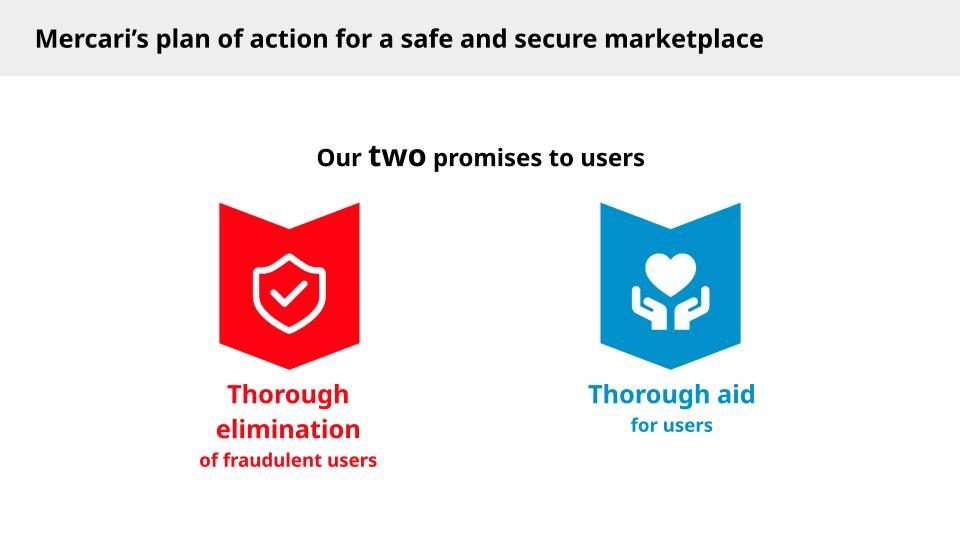
However, after we announced our new trust and safety policy in May 2025—centered on “thorough elimination of fraudulent users and thorough aid for users”—the direction shifted. We felt we needed to disclose information more comprehensively than we had originally planned.

From that point through the final stage, the discussions intensified. Slack threads ballooned with ideas—“Let’s add this too,” “Can we include that?”—and we had evening meetings with @Haru.H to refine the content. It felt like being in a last-round editorial room.
@nakakoh: One metric we chose to disclose was the “inquiry rate due to item issues (incident rate).” At first, we didn’t plan to publish it since we couldn’t find examples of other companies disclosing anything similar. But after the May announcement, we agreed that if we wanted to show our commitment to going all-in on transparency, these were exactly the kinds of numbers we needed to share.
Because of discussions like these, I think we ended up with a report that truly reflects our desire to stand by our users. And judging from the reactions after publication, this metric in particular drew a lot of interest. I’m glad we decided to disclose it as a key indicator.
@betts3: Information related to CS is especially delicate. However, after extensive discussions with data analysts and many other stakeholders, we were able to publish specific metrics for the first time. These included the figure showing a 1.9x increase in compensation provided to users and data on how much faster we now deliver compensation.
Initially, we wanted to give up on disclosing CS-related data due to the lack of precedent. Looking back, I realize we shouldn’t have dismissed it just because it seemed difficult. We needed to return to the core question—why we wanted to publish this report. As the editor-in-chief, I should have pushed harder to make it happen. That’s something I reflect on now.
Overcoming a Turbulent Final Phase, and the Positive Feedback That Followed
—Hearing how you worked backward from the ideal outcome and saw it through was inspiring. It sounds like the final days were intense. What challenges stood out?
@umenok: The urge to showcase Mercari’s transparency was shared across the company, so one of the toughest parts was distilling the many ideas and requests we received from internal stakeholders into a single, coherent report.
As conversations progressed about how we could meaningfully shift user perception, it became clear that merely publishing the same type of data as other companies would not be enough. We kept revisiting the content again and again, asking ourselves whether there was anything more we could disclose. Eventually, we made the call: if we wanted to be true to our commitment, we needed to publish certain numbers, even if it meant going where no company had gone before.
@betts3: The number of Slack mentions right before release was unbelievable (laughs). Our slides were flooded with comments and feedback from Legal, the Privacy Office, Security, and many others.
@umenok: There were so many last-minute comments. But I think that reflected how much people across the company believed in this idea, and how strongly they felt about pushing transparency even further. Bringing all of those expectations together into one report was definitely a challenge, and I’m really grateful to @betts3 for driving it through to the end.
—After publishing the Transparency Report, what kind of response did you see from the public?
@betts3: Reports that emphasize honesty don’t usually generate big buzz, but we saw the opposite. Media coverage kept increasing, and general readers responded positively. Some long-time Mercari users even told us that they had been worried by recent news reports, but felt reassured after reading the Transparency Report and appreciated that we were taking issues seriously. Members of the Mercari Salon community also said the report helped them understand the current situation and expressed appreciation for the transparency. The response was far more positive than we expected.

—Finally, what are your thoughts on the future? How do you want to approach future editions of the Transparency Report?
@umenok: Our commitment to trust and safety doesn’t end with publishing the Transparency Report. This experience made us realize that it’s not enough to simply say we’re working on trust and safety—we need to show users the actual numbers, and do so with sincerity.
External experts also told us that without specific data, it had been difficult to understand what kinds of countermeasures we were taking, and that the report helped make things clearer. We want to continue publishing not only what we’re doing well, but also what still needs improvement. By consistently sharing these details, we hope to keep building a cycle where users feel increasingly safe and confident using Mercari.
@Haru.H: For a report like this, continuity is incredibly important. Publishing numbers we had never disclosed before was a major step forward, but now that we’ve started, we can’t pick and choose metrics that are convenient for us. We need a consistent mindset that prioritizes transparency regardless of the situation.
@nakakoh: Fulfilling our responsibility to disclose information also drives motivation inside Mercari. Publishing numbers every six months through the Transparency Report will naturally spark future action—questions like, “This number hasn’t improved yet, so what initiatives should we try next?” The report isn’t just about showing our efforts to the outside world; I’m confident it will also become a driving force inside Mercari, strengthening motivation and accelerating the work we do.
@mai.i: For me, transparency shouldn’t be about sharing information that benefits the company; it should reflect what users genuinely need to know. That means consistently capturing the right data so we’re ready to share our work at any time, and proactively suggesting initiatives that could be included in future reports. I want to build a structure where teams actively support each other to keep the report meaningful.
@betts3: Looking ahead, I think storytelling will be key. Mercari will celebrate its 13th anniversary next February, and I want to ensure this report becomes part of the story of how we’ve evolved. Since this was the first edition, our goal was simply to get the output out. But from here, we want to update the report so that the data, the people behind the work, and Mercari’s values are all visible and connected.
Share


