

2026-3-10
Mercari’s Search and Discovery Experience: Striking a Balance Between Needs and Surprise Finds
Share


The experience of searching for an item on Mercari is undergoing a dramatic evolution. Mercari is transforming into a platform where users can make discoveries and come across unexpected treasures while still reliably finding the items they are looking for.
Driving this major transformation are the Search and Discovery Teams, which leverage machine learning (ML) to enhance the user experience. How do the product managers (PdM) of this team collaborate with highly specialized engineers to create value and enhance the user experience?
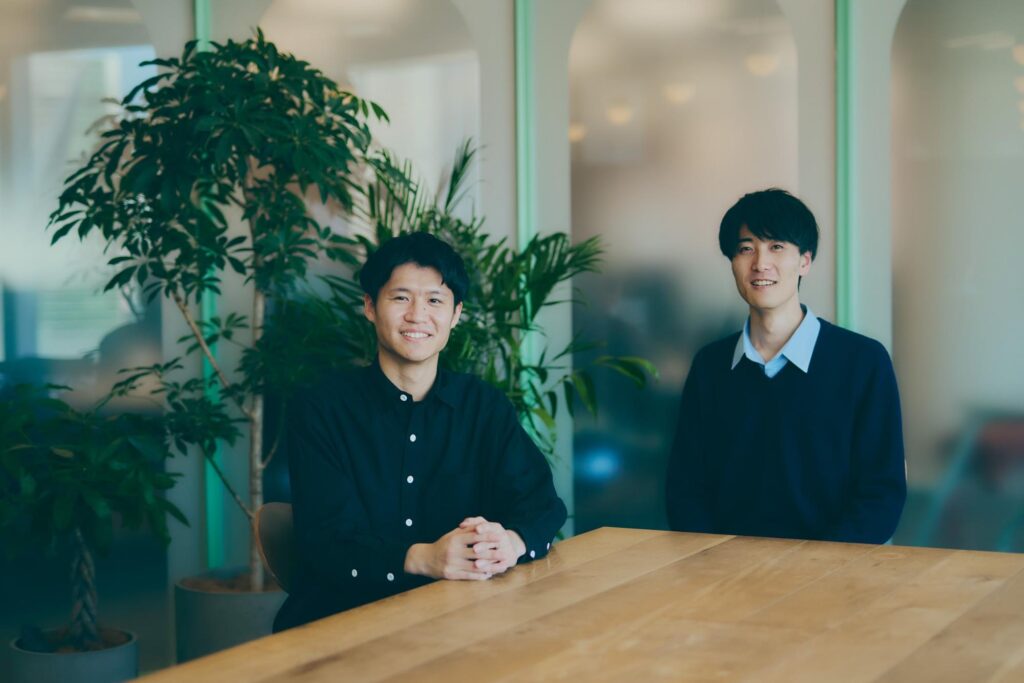
We spoke with Shoma Ishimoto (@shouma) and Shinya Yaginuma (@yaginuuun), who are leading the charge into this domain, to get a behind-the-scenes look.
Profiles
-

Shoma Ishimoto (@shouma)
After completing his master’s degree, Shoma joined Mercari as a new graduate in 2023 as a data analyst. He worked on product improvements through data analysis before transitioning to product management in 2024, focusing on search algorithms and UI/UX optimization. He now manages the Matching Team, which drives improvements across search, listing, and product metadata domains.
-

Shinya Yaginuma (@yaginuuun)
Shinya joined Mercari in 2020 as a data analyst, where he analyzed data to improve the Japanese version of the Mercari app. He later worked as an ML engineer before transitioning into product management. Today, he leads improvements in the recommendations domain as the manager of the Discovery Team, which focuses on driving purchases and listings by matching users with items.
Shifting the product’s focus to browsing for fun
─To start off, can you tell us about the background behind the changes to Mercari’s search and recommendation experience?
@shouma: The problem we set out to solve was that Mercari was becoming an app people only opened once they already knew what they wanted.
Due to the recent surge in popularity of social media and other e-commerce platforms, the frequency at which users open the Mercari app and the time they spend on the app have been on a downward trend. So we feel that unless we offer users the experience of casually browsing and discovering new items, we risk losing touch with them over the long term, which will ultimately limit the company’s growth.

@yaginuuun: Mercari users often come to the app with a clear objective, such as wanting to buy an item at a lower price than elsewhere, or searching for items that have sold out in primary distribution channels. Up until recently, we focused on optimizing our existing recommendations feature as a shortcut that complements the search feature.
However, this approach lacked one other important factor of searches: creating motivation for new purchases through encounters with unexpected items or keywords that the user had not originally thought of. We’re now working through trial and error to create more moments of serendipity.
─Could you tell us about the mission of each of your teams?
@shouma: My team is focused on the area of search and discovery. For the search aspect, we aim to provide an experience where a user who has a clear item in mind can be matched with that item, as well as support encounters between users and items that exceed expectations, even when users have needs that are vague or difficult to articulate.
@yaginuuun: The mission of the Discovery Team is to have users enjoy the process of exploring items. We help users efficiently take a shortcut to the items they want, while also facilitating encounters with new items that users want but otherwise would not have come across. It’s like the excitement of unexpectedly finding a hidden gem in a thrift store when you casually stop by—that’s the kind of experience we want to provide.

Understanding the intent behind keywords
─What kind of product improvements are you implementing?
@yaginuuun: One specific improvement is that we made significant changes to the structure of the home screen. Previously, item suggestions were mainly based on specific keywords. Now, we’re building on that foundation while also diversifying the content presented to users.
For example, there is a feature that suggests trending search keywords, which presents the users with keywords they have not yet seen but that are currently trending within Mercari. Also, we have implemented a timeline that displays best-selling items in real-time. This feature shows popular items that have recently sold, and is designed to prompt them to explore the app after seeing how many other amazing items are being sold on Mercari right now.

─What about product improvements to the search domain?
@shouma: In the search domain, we are strengthening personalization by going beyond traditional keyword matching. Consider a scenario where a user is searching for the name of a famous sneaker brand. Depending on the user, what they are looking for varies: some are looking for regular children’s shoes, others casual sneakers for adults, and still others rare vintage models. We have implemented a system that learns user browsing habits and preferences such as color, size, and price range, and presents items they are likely to want to see at the top of the home screen, even if their search keywords are vague.
We have also introduced an image search feature that allows users to find items they want but can’t describe in words. Because users can search by image, they can find a bag they’ve seen on social media or locate items similar to clothes they already own, for example. This feature has been very well received, mainly in the fashion category.

Pioneering a new experience of exploration through real-time capabilities
─Could you tell us about the real-time personalization you’ve been focusing on recently?
@shouma: As we worked on using browsing history to further personalize search results, we found that more recently viewed items more strongly reflect the user’s preferences.
Currently, we are working on real-time sorting based on user behavior. For example, if you view an item that appears at the top of the search results, the items displayed as you scroll will be replaced by similar items based on what you previously viewed. This technology instantly optimizes the sequence of items based on user behavior. Much like social media platforms such as TikTok, results are updated in real time with each interaction. Mercari is also exploring experiences that keep users engaged and encourage longer, more immersive browsing.

─That sounds like it would provide exactly the kind of immersive experience you get with social media.
@shouma: Yes, definitely. But, determining how much focus to place on the present moment is extremely challenging. Striking a balance between preserving diversity and leaning into current interests shapes how enjoyable item discovery feels.
@yaginuuun: Finding the right balance in optimization is definitely the most difficult part.
@shouma: When conducting surveys with users, some say, “I want to enjoy the process of searching on my own, so I don’t need an overload of recommendations.” According to them, browsing is not simply about the model anticipating their every move and shortening the time to purchase.
@yaginuuun: One topic that often comes up in our team is that a party where no one knows each other isn’t much fun, but a party where everyone already knows each other can also feel dull. Striking just the right balance—where things feel familiar, yet there’s always a refreshing mix of new faces (i.e. discoveries)—is key to keeping people engaged and enjoying themselves over time. The question of how much novelty to introduce has a depth and richness that can’t be measured by a single metric.
The role of the PdM: Defining outcomes rather than output
─Is there anything you keep in mind as a PdM when working with a large number of ML engineers?
@shouma: The Search and Discovery Teams work on projects with many ML engineers, and most solutions involve technical approaches. The field of machine learning is one where knowledge is constantly being updated, and that makes it difficult to determine how deeply a PdM should delve into the technical side of things.
As a PdM, what I value most is focusing on defining outcomes, not just output. For each task, I ask myself which metrics I want to improve, and by how much. Or, I ask what kind of qualitative results I would consider ideal for a certain keyword. I focus on defining this goal more clearly than anyone else and on creating an environment where engineers can autonomously develop solutions.
@yaginuuun: It’s also important to be able to provide engineers with accurate information. Of course, the overall business strategy comes first, along with translating and sharing user insights gained from UX research.
Ideation without a clear purpose or sufficient information sharing inevitably leads to a technical bias. One of the most rewarding aspects of being a PdM is providing fresh perspectives that inspire engineers to come up with new ideas—like realizing that they could solve a problem by applying a certain technology in a new way.

─What kind of processes do you follow when conducting such hypothesis testing?
@yaginuuun: Mercari has a strong culture of A/B testing, which means we frequently validate using metrics.
@shouma: This area is challenging because of the trial-and-error process involved—changing the ML model may not necessarily directly lead to solving user issues, so there is a sense of uncertainty.
For example, if the numbers in an A/B test are poor, we have to ask whether the problem was the way the model functioned, or whether it was how the problem was defined. To help make that distinction, we have recently been implementing a qualitative evaluation process for every hypothesis, where we manually review the difference in outputs between old and new models ourselves before conducting A/B tests.
─What is your take on the differences between the typical role of a PdM and the role of a PdM in this domain?
@yaginuuun: One thing they both have in common is that the PdM is accountable for the deliverables of the development team. However, PdMs in this domain need expertise to understand the trends in ML and explain what changes were made in implementation and how they create value for users, in both Japanese and English, and in both technical and business terms.
@shouma: While this is not a concept limited to our domain, I think it’s also essential to have a broad view of our entire marketplace platform. For example, improving search accuracy starts with making sure item information is correctly linked to a listing when the listing is created. So, we may be expected to collaborate with the PdM responsible for the item screen to define input fields, design the flow of data across different versions of the app, and take action with a broad perspective.
Mercari fosters a close-knit culture across its product teams. This makes collaboration easy, which is a significant advantage when it comes to leveraging data on a large scale.
Creating the next search and discovery experience
─Lastly, could you share your thoughts on the future of search and discovery?
@shouma: Looking ahead, our immediate focus is to make the Search and Discovery Teams more technical and sophisticated, and we’re already moving in that direction. At the same time, as large language models (LLMs) like ChatGPT become more widespread and fundamentally transform the nature of search, we are actively exploring what the next generation of search interfaces should look like.
Personally, I want my team members to approach our work with both a broad perspective and attention to detail. Our team is the ideal environment for those who enjoy thinking of the bigger picture that encompasses company-wide challenges and our overall journey, as well as those who have the tenacity to focus on the fine details of ML behavior and the numbers from A/B testing.
@yaginuuun: I also want to further strengthen the seller perspective. Mercari is a “two-sided” marketplace, meaning that the discovery experience only comes to life with enticing listings, which also bring joy to the users making purchases. So, we need to maximize how AI can help users discover new listing needs and create success stories that make sellers want to list over and over again. There is a mountain of work to be done.
From the outside, Mercari may seem like a fully developed service, but from our perspective, even in core areas like search and discovery, there is still tremendous potential for growth. So, if you’re someone who loves proactively identifying opportunities and creating value, we’d love to build the future of Mercari together with you.

Photographer: Tomohiro Takeshita
Share


